
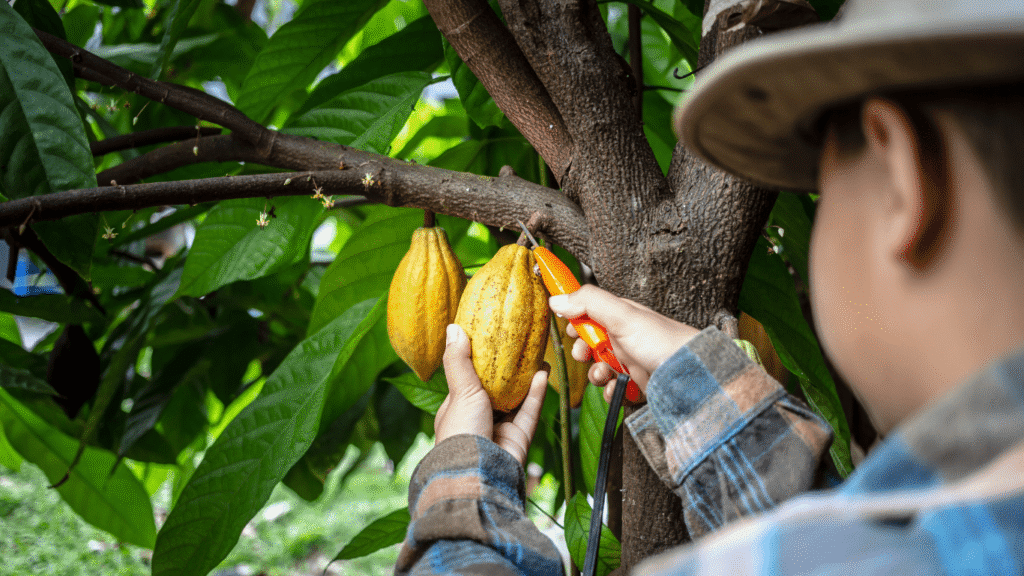
1. Why Sustainable Cocoa Farming Matters
The global cocoa sector faces increasing pressure as climate change, soil degradation, and socioeconomic challenges disrupt long-term production. As a result, sustainable farming has become crucial to secure a stable cocoa supply while protecting the environment and supporting farming communities.
Aligned with this mission, Nusvara Cocoa is committed to strengthening sustainability across its entire supply chain.
2. Environmentally Friendly Land Management
To preserve land quality, sustainable cocoa farming emphasizes environment-conscious agricultural practices, including:
-
using organic or natural fertilizers,
-
minimizing chemical pesticides,
-
conserving soil and water,
-
implementing agroforestry systems.
Moreover, agroforestry enhances biodiversity, improves soil structure, and allows cocoa trees to grow naturally alongside other crops.
3. Improving Farmer Welfare
Sustainability also focuses on the people behind the production. Therefore, supporting farmers is essential to ensure both productivity and long-term industry growth. This includes:
-
increasing yields,
-
reducing production costs,
-
providing training and modern farming techniques,
-
securing fair and stable income.
Consequently, farmers can produce higher-quality beans while elevating their economic well-being.
4. Adapting to Climate Change
Because cocoa is highly sensitive to climate variations, farmers must adopt resilient and adaptive strategies, such as:
-
using climate-resistant seedlings,
-
applying efficient irrigation systems,
-
managing shade trees,
-
conserving soil moisture.
Through these methods, cocoa production can remain stable despite unpredictable weather patterns.
5. Better Cocoa Bean Quality
Sustainable farming does not only protect the environment—it also improves bean quality. Farms that adopt responsible practices tend to produce cocoa with:
-
standardized fermentation,
-
optimal drying processes,
-
minimal chemical contamination,
-
improved post-harvest handling.
As a result, the cocoa powder, butter, and liquor derived from these beans are superior in consistency and flavor.
6. Meeting International Market Demand
Today’s global buyers—especially in Europe, Japan, and the United States—increasingly prioritize sustainably sourced ingredients. Therefore, many markets now require:
-
sustainability certifications,
-
full traceability,
-
lower carbon footprints,
-
ethical sourcing standards.
By meeting these expectations, Nusvara Cocoa enhances its competitiveness in the global marketplace.
7. Supporting Local Economic Growth
Beyond farm-level benefits, sustainable cocoa farming drives broader economic development by creating:
-
new employment opportunities,
-
higher community income,
-
improved food security,
-
stronger local economies.
Thus, the cocoa industry generates long-term value for both producers and surrounding communities.
Conclusion
In summary, sustainable cocoa farming is essential to secure the long-term future of the global cocoa industry. Through environmentally friendly practices, farmer empowerment, and strict quality standards, Nusvara Cocoa supports a responsible, resilient, and future-ready cocoa supply chain.